AI News Daily 12-09
AI News | Daily Morning Read | Web-wide Data Aggregation | Cutting-edge Science Exploration | Industry Free Voice | Open Source Innovation Power | AI & Humanity’s Future | Visit Web Version 🚀 | Join Group Chat 👋
Today’s Rundown
Kuaishou KwaiLing's Subject Library launches, boasts 96% accuracy for multi-angle generation from a single image, Pro costs ¥29/month.
Perplexity's BrowseSafe hits 91% prompt injection defense; Cristiano Ronaldo jumps in with investment and endorsement.
Stanford's CS146S bans traditional coding, demands AI tool development, waitlist over 200 – talk about hot demand!
ChatGPT's got a new trick: cancel your sub, get a free month. Meanwhile, Luo Yonghao calls AI phones "fake hype," and Doubao gets the axe from major apps.
MIT pinpoints a "language chip" in the human brain, tiny at 4.2cm³ (strawberry-sized!), after 15 years of research, now open source.
Products & Feature Updates
Kuaishou KwaiLing AI just dropped a major update: its new Subject Library (AI News) on the O1 model. It lets you upload a single image and generate multiple angles and lighting variations, even supporting cross-scene calls. The system automatically pulls out style keywords, and the Pro version goes for ¥29/month. This is a game-changer for filmmakers, who can now batch-generate storyboards, and merchants, who can slash virtual try-on video costs by a whopping 90% 💸. Plus, multi-person collaboration is coming next quarter!

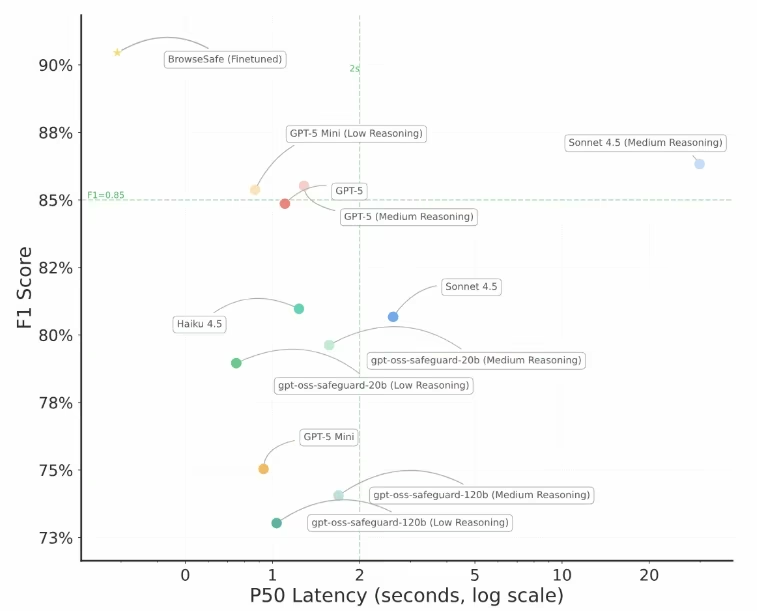
Perplexity just rolled out BrowseSafe, its new defense system that boasts a 91% success rate against prompt injection attacks – that’s 6 percentage points higher than GPT-5! And get this: Cristiano Ronaldo himself announced an investment in the company and signed a global endorsement deal, with a new Fan Interaction Hub (AI News) coming to the platform. While BrowseSafe has open-sourced its benchmarks and models, its detection rate for multi-language attacks is currently 76%. FYI, last year’s Comet browser already supports high-privilege session operations.
Stanford’s CS146S is shaking things up by completely banning traditional coding! Students are now required to develop software using Cursor and Claude (AI News) , and they even have to submit their chat logs. The waitlist? Over 200 people – it’s super popular 🔥! This ten-week course covers everything from coding agents to terminal automation and security vulnerability detection. The main lecturer, Eric, who previously worked with Stanford’s NLP group, will be launching a public version of the course for professional developers next year.
ChatGPT is offering a sweet deal: you can snag a free month of use if you cancel your subscription! Just hit ‘cancel subscription’ in your account settings on the web interface, and the system will pop up the free month offer. Several overseas users (AI News) have confirmed this works for Plus plans, but remember to do it in your browser. This move is likely a retention strategy, and for now, it’s only verified for individual accounts.
Luo Yonghao recently blasted the “fake hype” surrounding AI phones at the GeekPark conference, pointing out that Apple, Huawei, and OV haven’t launched any truly innovative AI phone products (AI News) in three years. Meanwhile, Doubao phones got a rough deal, with mainstream apps restricting accounts due to “abnormal operations.” Luo emphasized that ecological competition is far more complex than just technical prowess. He himself remains focused on AR entrepreneurship, believing that AI assistants will eventually become ubiquitous.
Cutting-Edge Research
MIT has zeroed in on the human brain’s “language chip,” and it’s tiny – just the size of a strawberry (4.2cm³)! A 15-year study published in Nature Neuroscience, involving 1400 fMRI scans, pinpointed the language network in the left inferior frontal gyrus. Data from 212 aphasia patients proved that language and thought modules are completely decoupled, and the probabilistic map has been open-sourced (AI News) . Both Meta and DeepMind have already cited this map to optimize large model architectures and brain-computer interface designs. Look out for a dual-region stimulation protocol coming in Q2 next year.
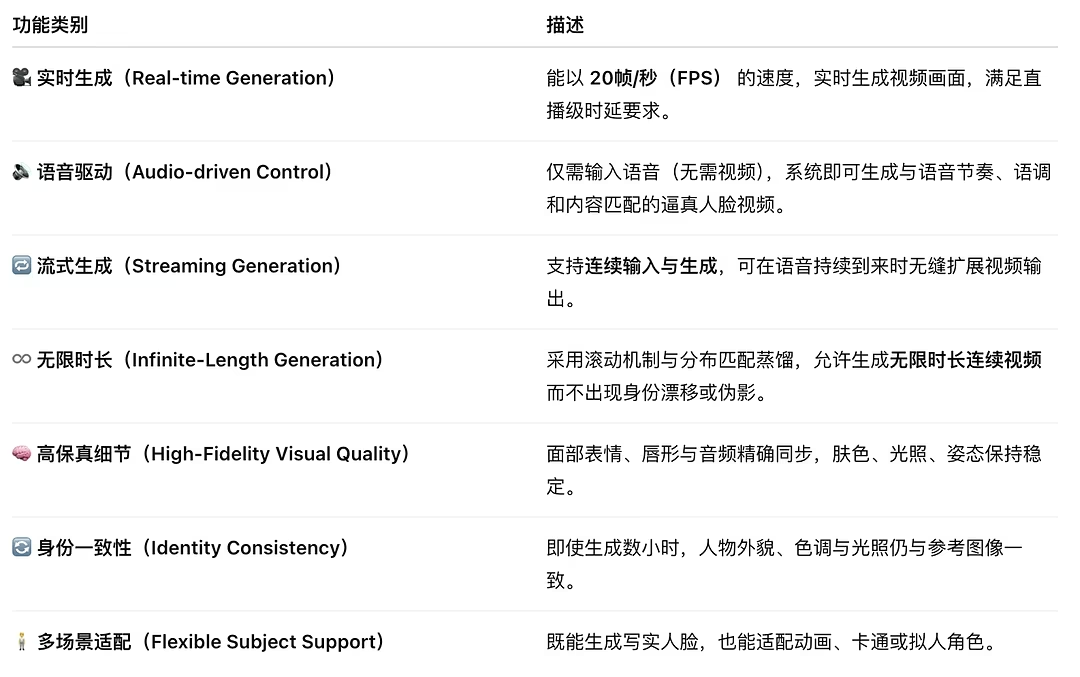
Alibaba just dropped Live Avatar, a system capable of real-time, infinite-duration virtual human generation! This bad boy supports 20 frames/second voice-driven animation and can run continuously for over 3 hours. It uses a three-layer anti-drift mechanism to keep character appearances stable and integrates with the Qwen3 model (AI News) for bidirectional language and expression interaction. The tech employs stream-block generation, with student models achieving teacher model quality through self-reinforcement training. The paper and code are already out there for everyone to check out.
Oh boy, we’ve got an academic crisis brewing! During ICLR 2026 submissions, a research team found 50 instances of hallucinated citations in just 300 samples, estimating hundreds across 20,000 total submissions. The big debate is heating up between author responsibility (AI News) and tool accountability 🤔. The community suggests using BibTeX verification and RAG retrieval, but even the detection tool GPTZero is facing questions about false positives. Academics are calling for cross-institutional disclosure and disciplinary mechanisms.
Google unveiled Titans, a new memory architecture for inference, but big caveat: they didn’t open-source the weights 🤦♀️. The paper proposes using gradients as “surprise signals” to instantly update memory modules, supporting super long-context self-modifying learning (AI News) . Their HOPE solution, combined with a CMS system, achieves hierarchical persistent memory. The community isn’t too happy, criticizing Google for only releasing the paper and not the model, a stark contrast to Meta and DeepSeek’s strategies. Safety discussions are now buzzing around data poisoning risks and alignment issues.
Stanford introduced LaserMix++, a semi-supervised LiDAR semantic segmentation framework that’s pretty slick. This framework integrates multi-sensor complementation, achieving feature distillation from cameras to LiDAR. It hits full supervised accuracy with just one-fifth of the labeled data and has already been validated across multiple driving datasets (AI News) . It supports general applications for cross-LiDAR representations, significantly slashing costs for re-shooting outdoor scenes. The tech features multi-modal LaserMix operations and language knowledge guidance.
Industry Outlook & Social Impact
McKinsey is dropping some serious numbers: they predict AI will replace a whopping 800 million jobs by 2030, but it’ll also create 130 million new ones. A Berkeley professor is ringing the alarm 🚨, warning that all professions, including CEOs, will feel the impact. Brookings research shows that the US alone could see 1.3 million to 2.4 million job replacements within a decade. Affected industries (AI News) include driving, logistics, accounting, and healthcare. An IBM exec stressed that managers not leveraging AI will be left behind, urging society to focus on retraining and psychological adaptation.
A recent Hong Kong outdoor robot competition totally highlighted the performance gap between humanoid and quadruped robots. Zhejiang University’s Wongtsai team bagged the $150,000 prize 🏆, with their quadruped robots absolutely crushing humanoids in tasks like waste sorting and off-road navigation. The competition threw in some serious outdoor extreme scenarios (AI News) , exposing the weaknesses of humanoids like their high center of gravity and fewer contact points. With judges like international scholar Liu Yunhui on board, the event is pushing robots from cool demos to real-world, reliable applications.

Anthropic just dropped a game-changing VLM self-improvement framework that needs zero human annotation. How cool is that?! This method synthesizes multi-modal instruction pairs and generates reasoning trajectories, boosting Llama-3.2-11B from 0.38 to 0.51 on VL-RewardBench. It even outperforms 90B models and GPT-4o (AI News) , showing significant improvements in both hallucination and reasoning. The iterative process includes quality grading and self-filtering.
Anthropic also unveiled CookAnything, a multi-step recipe image generation framework. This system uses step-region control and flexible RoPE encoding to churn out coherent recipe illustrations (AI News) of any length. Its cross-step consistency control keeps ingredient details on point, outperforming existing methods in both trained and training-free settings. The applications are super broad, covering guided media and programmatic content creation.
Top Open-Source Projects
Cloudflare just launched VibeSDK, an open-source “vibe coding” platform that’s already got 3.6k stars ⭐! Built entirely on the Cloudflare tech stack, it lets developers set up their own custom coding environments (AI News) . The project comes with a complete deployment solution and docs, making it perfect for team collaboration. The community’s buzzing about how integrated the toolchain is, significantly lowering the barrier to setting up your own vibe coding platform.
Say hello to Open Notebook, an open-source alternative to NotebookLM that’s already racked up 13k stars ⭐! It offers way more flexibility and expanded features, supporting custom notebook workflows (AI News) . This project comes with a multi-language interface and a plugin system, and the community contributions are super active. It’s an ideal fit for research teams and educational institutions looking for private deployment.
Anthropic has dropped a new collection of Claude API Quickstart projects, grabbing 11.4k stars ⭐! It includes several deployable application examples, covering everything from chatbots to document processing. The official repository (AI News) offers detailed tutorials and best practices to help developers quickly integrate Claude’s capabilities.
Social Media Buzz
Holy smokes, tilt-shift photography prompt optimization is creating stunning results and blowing up online 📸! Netizens shared an optimization method (AI News) that significantly boosts generation quality, and the comment sections are flooded with users showing off their amazing work. Key technical points include depth-of-field control and miniature effect parameter adjustments, applicable across various image generation models.

Whoa, 100-million token usage data is unveiling some wild new rules in AI economics! The report indicates that price isn’t the decisive factor (AI News) ; instead, inference quality and workflow integration are king 👑. Role-playing and programming account for nearly 90% of usage, with Gemini showing strong general-purpose tool attributes. Interestingly, open-source mid-sized models are seeing a climb in private deployment scenarios.

The Claude Diary project just dropped, making code assistants capable of continuous learning! How it works: it extracts experience and updates memory (AI News) through a journaling and reflection mechanism 🧠. The system automatically distills rules like Git workflows and code styles from conversations. The author saw a significant boost in development efficiency after just one month of use, with the tech drawing inspiration from the CoALA architecture and generative Agents papers.
Get ready for some futuristic vibes ✨! Cosmic UI, a new sci-fi themed component library, just launched with full React framework compatibility. Its design takes cues from sci-fi works and uses TypeScript for robust type safety. This open-source project (AI News) comes with complete documentation and examples, helping developers quickly integrate a sleek, techy interface. Plus, it supports compatibility with mainstream frameworks.

Ever tried running AI agents for hours on end? Well, long-running Agent practice by developers using Claude Code and Codex is revealing a new bottleneck: detailed requirements documentation 📝. They shared their multi-hour operation experience (AI News) and found that precise documentation became absolutely crucial. Good news is, they’ve already implemented an automated requirements generation feature; now, the only real limit is token cost. This method is based on practices outlined in Anthropic’s blog guidelines.
AI Daily Briefing: Audio Version
| 🎙️ Xiaoyuzhou FM | 📹 Douyin |
|---|---|
| Laisheng Xiaojiuguan (The Next Life Pub) | Self-Media Account |
 |  |